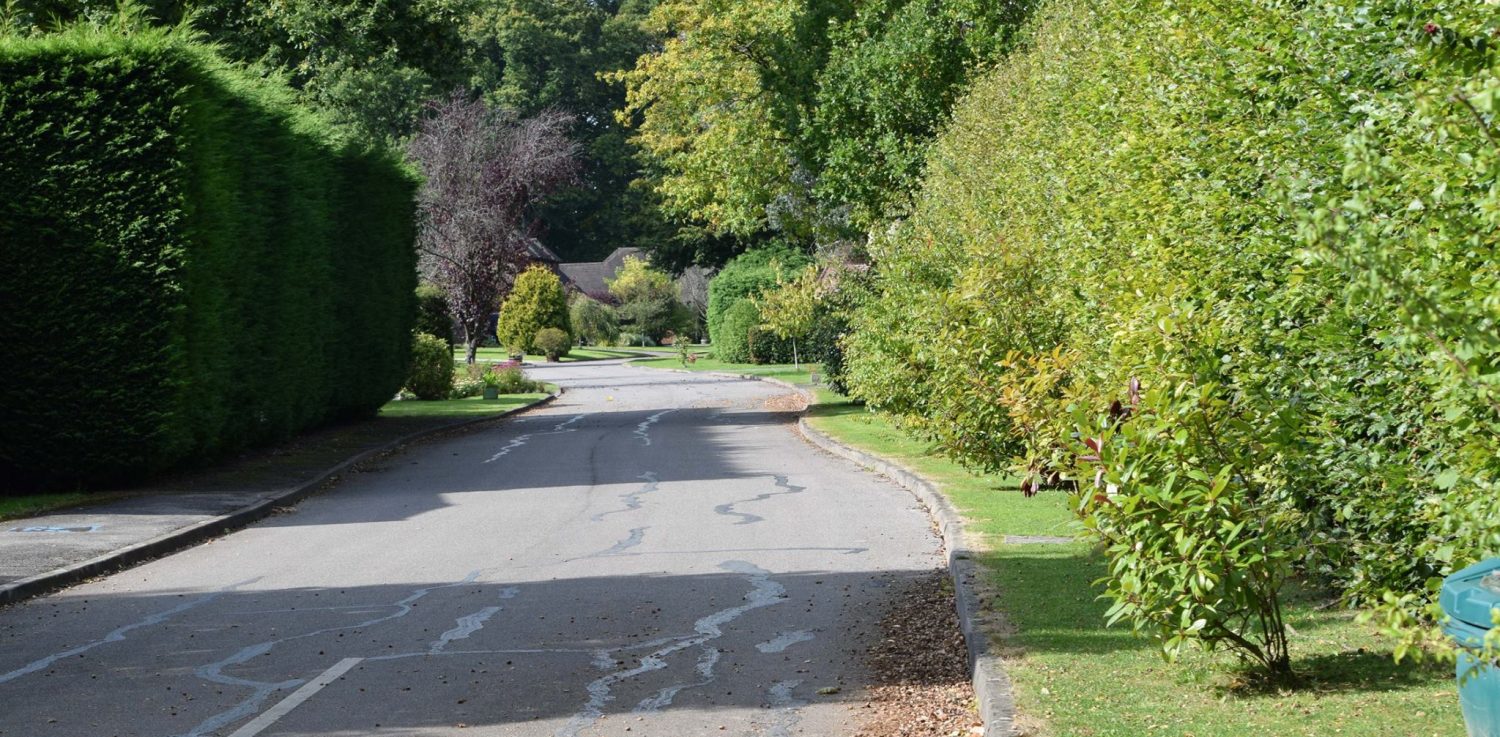
Typically, the roads were formed to include a 40ft swathe of land from edge to edge. This was to cater for future expansion in case the roads were ever adopted by the council and needed typical additions such as two distinct lanes plus pavements. But this is the general case. Since the Brake Estate was selling plots to individual buyers and these sales spanned over several decades, there are plenty of variations and exceptions.
The best reference is the title deed plan for the private roads, which is WSX285419. This is a public record document on land registry and available to all, so no problem to publish it here. You could acquire an official copy of the original for £6.
WSX285419 Title Plan – Ifold Private Roads
The boundary is shown by the red line, with the dotted line being the edge of the road.
Note that land registry boundaries are considered “general boundaries” which means they are open so some caveats, interpretation and debate. We often find ourselves standing at the boundary looking for ancient markers such as earth mounds, ditches, streams, or alignment with neighbouring properties.
See https://hmlandregistry.blog.gov.uk/2018/02/27/drawing-the-line-on-boundaries/
There are many properties in Ifold where there is no clear boundary, for example lawns that reach all the way to the road. In most cases IEL owns the first section, often 2m wide, but again this could be more or less depending on title deed plans.
The verges are a necessary component of the roads, in many cases containing the ancillary ditches, even services such as high voltage cables. IEL often adds posts and shrubs to prevent vehicles from mounting and damaging the verges, and we are allowed to do so since IEL is “in control” of the roads, with a maintenance plan taking care of those shrubs. There are plenty of cases where residents have planted their own shrubs, hedges and trees on verges, and while this personal care and attention is appreciated, it can be an issue where IEL then becomes responsible for the future maintenance and liability in case those plants start to encroach on the road. In some cases IEL has needed to ask residents to cut back their over-handing hedges/trees and in extreme cases IEL would have a contractor resolve the issue on safety grounds, and sending the invoice to the resident.